
I got myself invited to share my findings on “Contactless REM Detection in Natural
Sleep” at a sleep research lab. They were kind enough to loan me a clinical-grade EEG device: the CGX Patch, a
single-channel forehead EEG of the kind used in real sleep studies.
I first connected the CGX Patch EEG and only turned the INSPEC on two minutes later, so I had to manually dial the INSPEC logs two minutes back.
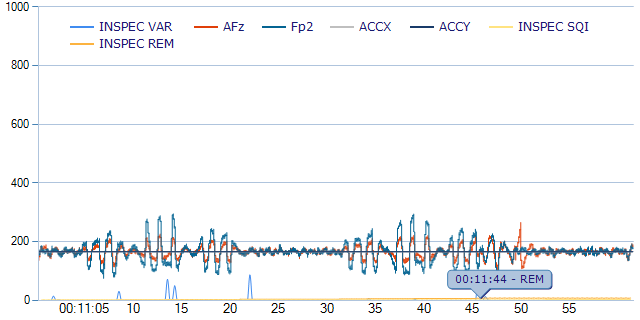
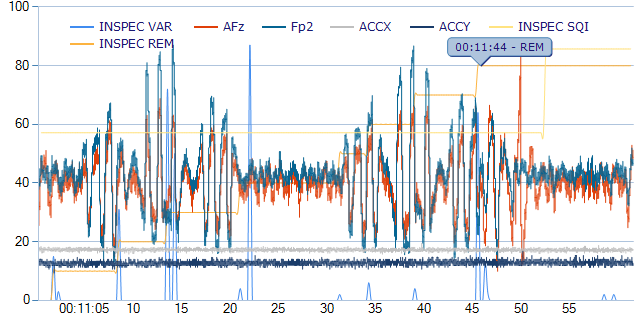
At 00:11, in the minute below, I moved my eyes in Morse Code patterns to spell out SOS twice. The eye movements show up clearly on both signals, as sharp deflections on the frontal EEG and as variance spikes on the INSPEC.|
|
Zoomed in:
|
|
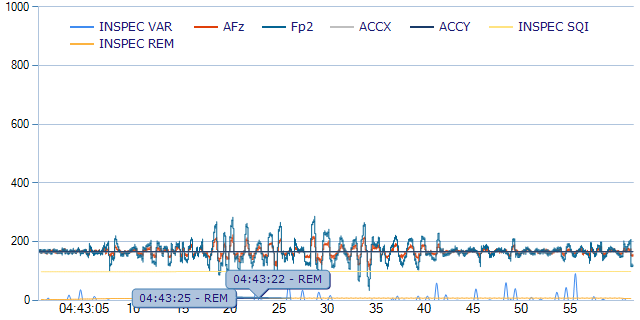
From 04:26 to 04:46 the INSPEC recorded a long run of eye movements during a dream.
Lined up against the CGX Patch EEG, the two track each other closely. The eye movement spikes the INSPEC pulled from
the camera sit right where the EEG puts REM.
|
|
Zoomed in:
|
|
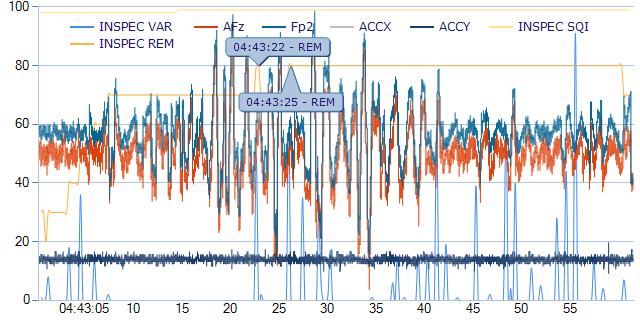
I have not run the EEG through a sleep stage classifier yet, so this is not scored
agreement. But the raw eye
movement signal from a camera on the nightstand and the raw EEG from a clinical device on the forehead, appear
to be describing the same
thing. From what I can see in Lucid Scribe, it looks very promising!
Download entry as INSPEC (LSD) (1.9 MB) | CGX Patch EEG (EDF) (183 MB) | Hour 0 Merged (LSD) (71 MB) | Hour 4 Merged (LSD) (71 MB).

