Category: States


Sleep and Consciousness Research Graph

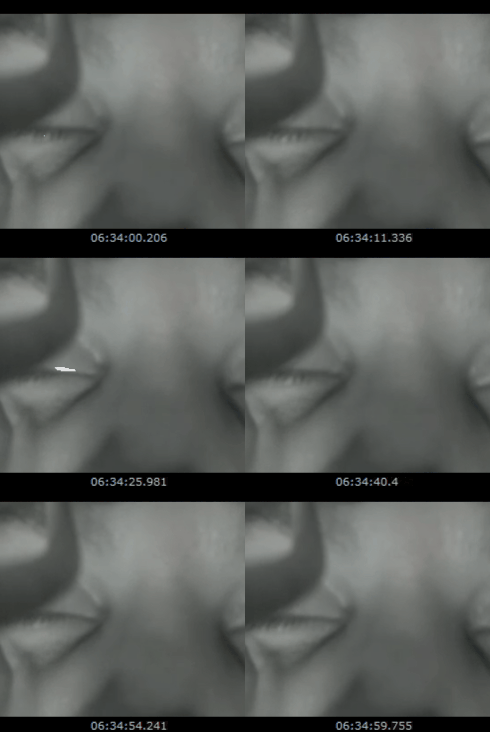
I caught another today… the pillow can be seen in the minute above and doesn’t affect the algorithm anymore.   

I have had a few inquires about using the setup without the headband and this shows that it could work if you can sleep close enough to the night-table or have the camera mounted above the bed somehow. I will try to record a session like that one night…

Sleep and Consciousness Research Graph

I now have an infrared LED shining down on me from a cupboard… and the recordings have been out of this world! Gone are the dark ages with just a few squiggly lines of questionable EEG signal quality.

The latest version of the Halovision plugin records an image-stream of any movements and Lucid Scribe automatically replays them when reviewing a session. This helped a lot with writing filters for the artefacts, like when the camera re-focuses.

The eye movements that triggered the audio track can be seen in the minute above. I was re-taming a hippo that I had saved as a baby in another life!

Here is the finalised release candidate of the Halograph EOG – a headband with a night-vision camera held in place by two bendable selfie-sticks:

It is more comfortable to sleep in than I had ever hoped. I can sleep on either side or on my back with complete freedom of movement with the 2 meter cable.

The age of light is nigh; this is light-bending!

EEG Stairs

Caught a nice flight of stairs from the OpenEEG channel in the minute below.

EEG Stairs

The signal quality tapered off here and there after that, which can only be seen in the raw EEG data… will add a signal quality channel to keep track of it.

Download entry as Lucid Scribe Data (LSD) with raw EEG data.

BP-REM

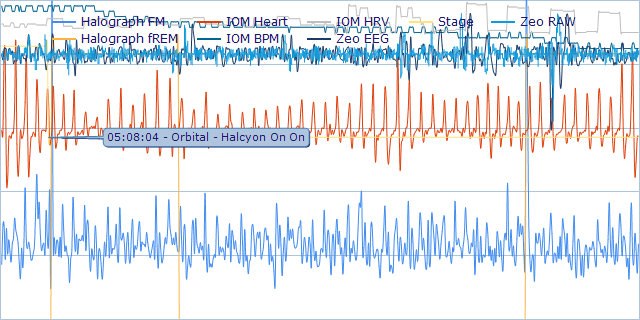
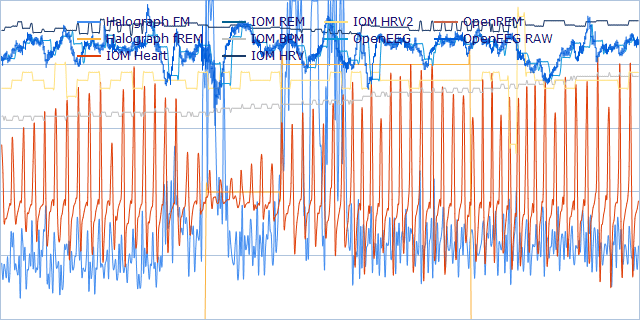
An interesting change in the heart rate variance in the top-right corner that might be indicative of REM sleep:

Change in HRV during REM

Download entry as Lucid Scribe Data (LSD) or Comma Separated Values (CSV).

Kapalabhati

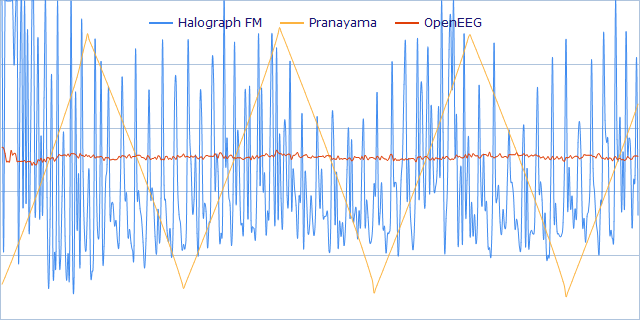
An exercise I picked up while practicing Bujinkan. The first printout shows four deep breaths a minute:

4 normal breaths

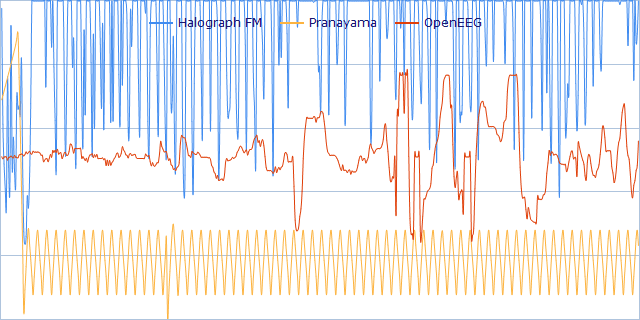
The second printout shows the rapid “shining” breaths, 60 active exhalations and passive inhalations in one minute:

Effect of Kapalabhati on EEG

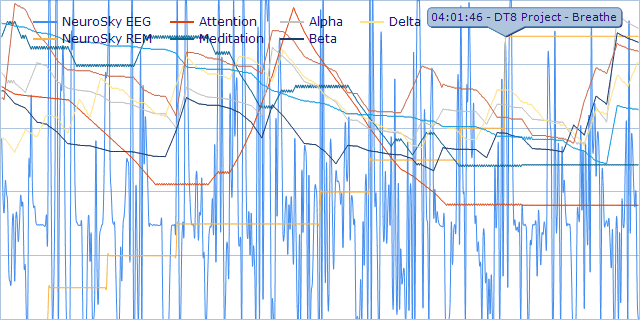
Notice the effect on the EEG channel. It feels exactly as pictured above. Although I have suspicion that a change in skin conductance (GSR) might be causing some artifacts. Perform Kapalabhati thusly:

Sit in the Lotus posture if possible and hold the head erect. Begin with an exhalation brought about by a rapid inward stroke of the abdomen. Inhalation follows immediately by relaxation of the abdominal muscles. Thus, inhalation is passive and automatic. Repeat this exercise at the rate of one exhalation per second. Look up at the end of the exercise, exposing the throat and hold the breath with the diaphragm.

Previously it was specified that the Lotus posture of yoga be employed for this exercise. The reason will now become apparent. When the breathing exercise described herein is properly performed over a long period, certain vibrations begin within the body. The vibrations, coupled with a feeling of exhilaration, lessen motor control of the limbs. In the Lotus, the legs are in a position impossible to undo without the aid of the hands.

This exercise is used to develop concentration.

Do not attempt while driving or operating machinery!

Download entry as Lucid Scribe Data (LSD) or Comma Separated Values (CSV).

I dusted off my LightStone and set out on a new quest to detect the dream state from the heartbeat. The heart rate variability (HRV) channel sometimes creates castle-like patterns during deep sleep like in the printout below: 

13 Strained Heartbeats at 0005

This pattern is sometimes interrupted – by movements, bad sensor readings and dreams perchance:

Eye Movement Count from EEG at 0017

I woke up at 0308 when the electrode gel dried up and triggered a string of false positives from the OpenEEG channel. I stayed up for 30 minutes for some Choline and Galantamine and was plagued by numerous false awakenings over the next 3 hours. I also tried out a EV-806A tENS unit at 40 Hz on Fp1 and Fp2 for a few minutes before sleep.

The BPM channel (grey) sometimes climbs of its own accord – that might be the first place to start looking:

Eye Movement Count from EEG at 0017

Download entry as Lucid Scribe Data (LSD) or Comma Separated Values (CSV).

Supplemental Boost

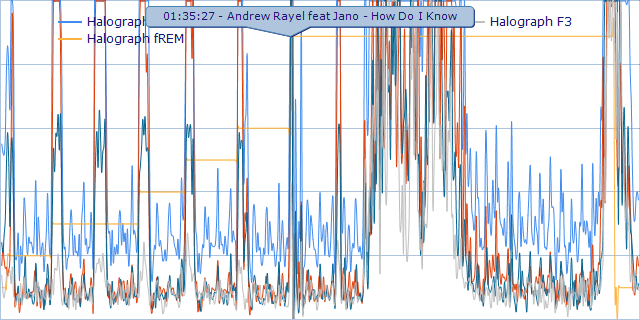
Effects of Supplements on Eye Movement at 0135
Thanks to neuralswarm from DreamViews I now have some Choline and Galantamine to test with. I took one of each just before sleep and recorded some nice patterns within the hour during which the audio tracks triggered. The dreams were very technical in nature and I was aware of heightened electrical activity in sections of two-dimensional grids in the frontal lobe. 

Download entry as Lucid Scribe Data (LSD), Comma Separated Values (CSV) or watch the video.

Sleep and Consciousness Research Graph
Some of my sleep data which potentially shows dream detection with sound activation (according to MPC) 

Download entry as Lucid Scribe Data (LSD) or Comma Separated Values (CSV).

Free Fall 2

EEG of Hypnagogic Jerk at 0101

I caught that feeling you get when you are startled awake by an intense falling sensation on file again, this time with EEG. At 0052 I was still awake and making sure the audio tracks were triggering, then at 0101 I twitched awake and checked the time.

The minute above shows the episode – the first spike was the twitch and seems to have flat-lined the channel for a few seconds. The rest of the movements are from me checking the time and settling again.

Download entry as Lucid Scribe Data (LSD) or Comma Separated Values (CSV). The CSV file doesn’t contain the RAW channel – it was running at 256 Hz and the CSV export doesn’t work for the illuminated plugins yet. I will fix that in one of the next updates.

After explaining the REM-detection algorithm to a friend over the weekend, I was inspired to shed some light on it by plotting each step in the loop on the graph so that it becomes easier to visualize. 

The first printout that I recorded last night, 5 minutes past midnight, shows the strained beats picked up by the halograph FM. The fREM channel can be seen counting up each blink or strained beat that peaks over the top line and then triggers the next track in the playlist after the 8th blink.

13 Strained Heartbeats at 0005

And the second printout, recorded at 0017, shows the same thing happening with the OpenREM channel from the OpenEEG electrodes.

Eye Movement Count from EEG at 0017

This will make it a lot easier to perfect the algorithm by highlighting where it was thinking about triggering. The tracks at 0618 made it into the dream and helped me stave off a hoard of zombies, but didn’t trigger lucidity…

Download entry as Lucid Scribe Data (LSD) or Comma Separated Values (CSV) or watch the video.