Download entry as Lucid Scribe Data (LSD), Comma Separated Values (CSV) or watch the video.
Category: Hardware
A dot is a gentle blink, so that the NeuroSky EEG channel spikes above 500, but below 900. A dash is more of a frown, or wink or raising of the eyebrows so that the NeuroSky EEG channel spikes above 900. To practice, reference the International Morse Code chart. Start with some E’s (dots) and then a T (dash). Then say SOS and finally CONSCIOUS.
Download entry as Lucid Scribe Data (LSD), view the source or watch the video.
Download entry as Lucid Scribe Data (LSD) or Comma Separated Values (CSV).
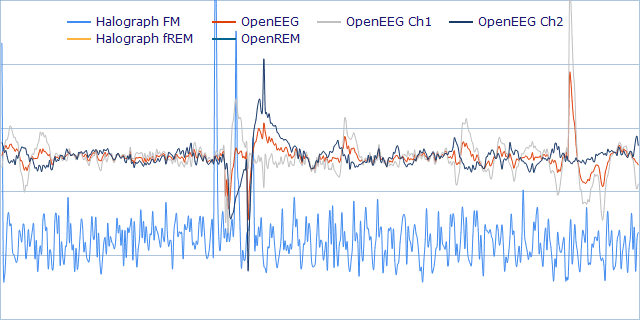
I caught that feeling you get when you are startled awake by an intense falling sensation on file again, this time with EEG. At 0052 I was still awake and making sure the audio tracks were triggering, then at 0101 I twitched awake and checked the time.
The minute above shows the episode – the first spike was the twitch and seems to have flat-lined the channel for a few seconds. The rest of the movements are from me checking the time and settling again.
Download entry as Lucid Scribe Data (LSD) or Comma Separated Values (CSV). The CSV file doesn’t contain the RAW channel – it was running at 256 Hz and the CSV export doesn’t work for the illuminated plugins yet. I will fix that in one of the next updates.
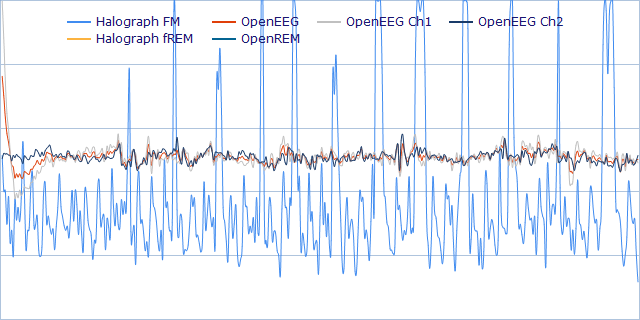
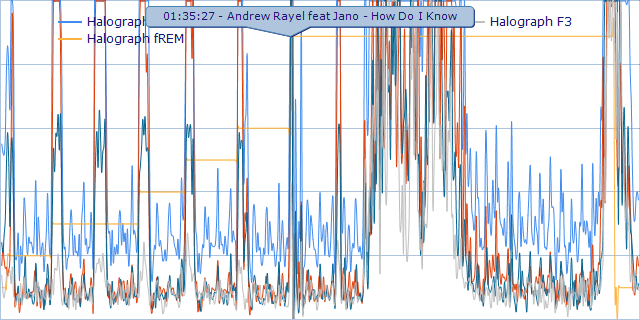
The first printout that I recorded last night, 5 minutes past midnight, shows the strained beats picked up by the halograph FM. The fREM channel can be seen counting up each blink or strained beat that peaks over the top line and then triggers the next track in the playlist after the 8th blink.
And the second printout, recorded at 0017, shows the same thing happening with the OpenREM channel from the OpenEEG electrodes.
This will make it a lot easier to perfect the algorithm by highlighting where it was thinking about triggering. The tracks at 0618 made it into the dream and helped me stave off a hoard of zombies, but didn’t trigger lucidity…
Download entry as Lucid Scribe Data (LSD) or Comma Separated Values (CSV) or watch the video.
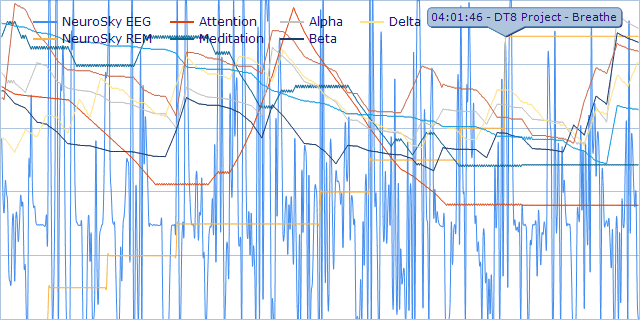
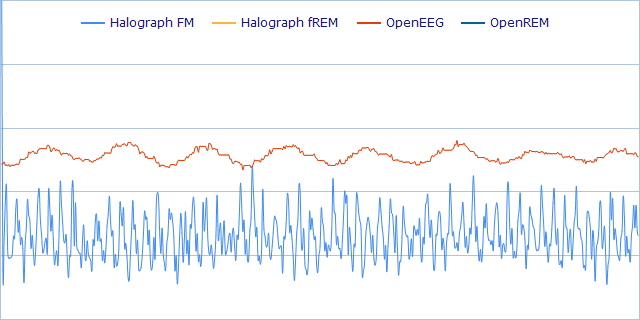
The first minute, 0143, shows a pattern that I have seen many times: a sequence of heartbeats where every third beat is three times as strong as a normal beat, 12 of which can be seen below. I have begun to suspect that this may be a phenomenon that only occurs in male subjects. Note that the EEG channels flatline.
Moving on, two and a half hours later at 0408 there are two such beats right before the onset of a marathon REM session that lasted half an hour.
And peaked with eye movements like this at 0412:
Only to end again with some strained beats at 0450. No idea what to make of that spike on channel 2, it seems to pop up quite regularly.
Download entry as Lucid Scribe Data (LSD) or Comma Separated Values (CSV).
The eight waves in the minute featured above seem to have repeated every hour, around the 50 minute mark, starting at 2 am. The relative quite in the accelerometer channel suggest that the waves aren’t artifacts. I might set an alarm for them one day.
Download entry as Lucid Scribe Data (LSD) or Comma Separated Values (CSV).
The algorithm didn’t trigger an audio track, as it was looking for multiple events like this in a row. I will update it to optionally trigger on only a single event, because of the vividness of the dream. The spike looks similar to when I open my eyes while awake.
Download entry as Lucid Scribe Data (LSD) or Comma Separated Values (CSV).
The Session is from Stage 1 to 6 , and by the way.. its a Coordinate Remote Viewing Session (CRV).
Download entry as Lucid Scribe Data (LSD) or Comma Separated Values (CSV).
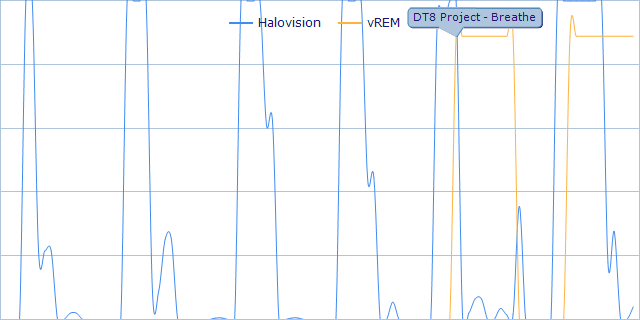
I have been working on a new plugin for Lucid Scribe, dubbed Halovision, that measures the amount of change between each frame from a webcam stream. The printout above was recorded while awake and blinking and shows the eye movement pattern that triggers the audio tracks. If you always wanted to try Lucid Scribe but haven’t had the hardware, now is your chance if your laptop has a webcam built in or your smartphone runs Android!
Download entry as Lucid Scribe Data (LSD) or Comma Separated Values (CSV).